Home - Industrial
Chemicals
Industrial Chemicals
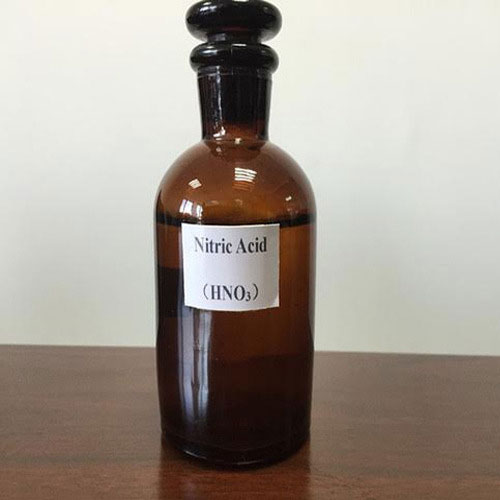
Nitric Acid

Nitric
acid with a chemical formula HNO3 is also known as aqua fortis or the spirit
of nitre and is extremely corrosive and toxic strong acid. Colorless when
pure, its older samples tend to acquire a strong yellow cast due to the
accumulation of oxides of nitrogen. This highly reactive oxidizing agent
used in the production of fertilizers, explosives, and rocket fuels and in
many industrial metallurgical processes.
| Appearance: |
Colorless to yellowish liquid. |
Odor: |
Suffocating, acrid. |
| Solubility: |
Infinitely soluble. |
Specific Gravity: |
1.41 |
| pH: |
1.0 (0.1M solution) |
% Volatiles by volume @ 21C (70F): |
100 (as water and acid) |
| Boiling Point: |
122C (252F) |
Melting Point: |
-42C (-44F) |
| Vapor Density (Air=1): |
2-3 |
Vapor Pressure (mm Hg): |
48 @ 20C (68F) |
Acetic Acid

Acetic
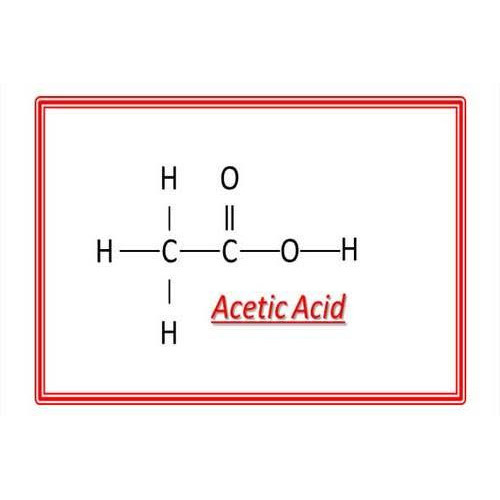
Acid is an organic acid, from which vinegar gets its sour taste and pungent
smell. This acid is weak and is only a partially dissociated acid, when in
an aqueous solution. Pure, water-free acetic acid is a colorless liquid,
which absorbs water from the environment and freezes at 16.5°C (62 °F)
to a crystalline solid. The pure acid, and concentrated solutions, are
dangerously corrosive. Mainly used in soft drink bottles, cellulose acetate,
photographic film etc, this is one of the simplest carboxylic acids.
Chemical Formula : CH3COOH
Common Synonyms : Ethanoic Acid, Methane Carboxylic Acid, Ethylic
Acid
Proper Shipping name : Acetic Acid, Glacial Acetic Acid
Physical Properties :
| Abbreviation: |
A/A |
| Appearance: |
Colorless Liquid |
| Molecular weight: |
60 |
Properties at 400C :
| Density: |
977.9 kg/m3 |
| Sp. Heat Capacity: |
0.53 kcal/kg0C |
| Thermal Conductivity: |
0.129 kcal/ m hr0C |
| Viscosity: |
0.906 cP |
| Melting Point: |
16.635 +/- 0.0020C |
| Boiling Point: |
117.870C |
Typical Analysis :
| Color: |
Colorless |
| Freezing Point: |
16.1 deg C |
| Specific Gravity: |
1.04 |
| Formic Acid: |
0.05% |
| Purity: |
99.80% |
Packaging :
| UN/No: |
2789 |
| Packaging group: |
II |
| Major hazard class: |
8 |
| Subsidiary hazard class: |
3 |
| Transport category: |
2 |
Applications :
Acetic Acid are used to manufacture acetic anhydride, cellulose acetate,
vinyl acetate monomer, acetic esters and chloroacetic acid. They also find
application in the manufacturing process of pharmaceutical dyes,
insecticides, photographic chemicals and as an acidulant and food
preservative.
Health And Safety Information :
| Flash Point |
40 deg C |
| Inhalation: |
Remove victim in fresh air and give oxygen if
necessary |
| Ingestion: |
Drink plenty of water and allow vomiting |
| Skin: |
Wash with plenty of water |
Formic Acid

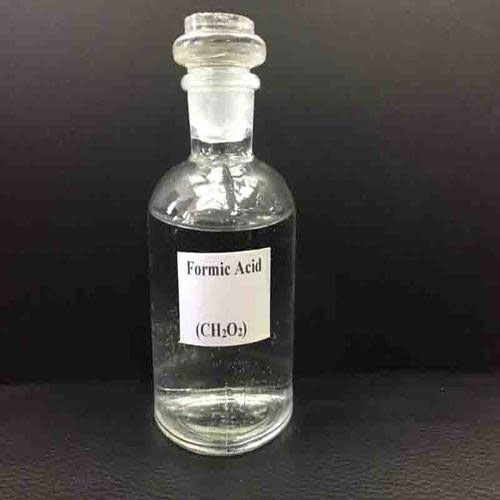
Formic
acid is also called methanoic acid is the simplest carboxylic acid, but can
also be viewed as an aldehyde. Its a clear, colorless liquid with a pungent
odor and infinite solubility. It decomposes easily in the environment into
carbon oxides and water. It acts as an important intermediate in chemical
synthesis and occurs naturally, most notably in the venom of bee and ant
stings.
Applications :
Formic acid find application as a coagulant for obtaining rubber from
latex, as an auxiliary agent for delining and pickling of fur fixing of dyes
in the leather industry and in processing of textile industry. These acid
also find application as an intermediate in manufacturing of basic drugs,
plant protection agents, pesticides, vulcanization accelerators etc. Formic
Acid are also used in preservation of silage and grams. It is also used in
electroplating and can be used as a solvent as well.
Synonyms : Methanoic acid; hydrogen carboxylic acid; formylic acid
CAS No.: 64-18-6
Molecular Weight : 46.03
Chemical Formula : HCOOH
Sulphuric Acid

Sulphuric
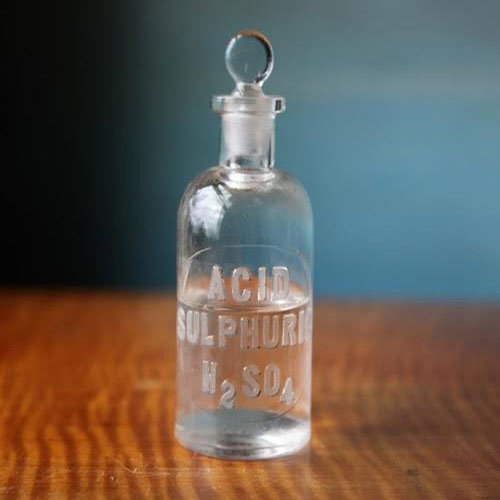
acid, is represented by the chemical formula H2SO4, is a strong mineral
acid. It has a strong pungent odour and is off white to light yellowish
white in color. Soluble in water, it is highly corrosive and an oxidizer.
Sulphuric acid has many applications, in lead-acid batteries for cars and
other vehicles, ore processing, fertilizer manufacturing, oil refining,
wastewater processing, and chemical synthesis.
| Appearance: |
Clear oily liquid. |
Solubility: |
Miscible with water, liberates much
heat |
| Specific Gravity: |
1.84 (98%) |
pH: |
1 N solution (ca. 5% w/w) = 0.3; 0.1 N solution
(ca. 0.5% w/w) = 1.2; 0.01 N solution (ca. 0.05% w/w) = 2.1. |
| Boiling Point: |
ca. 290C (ca. 554F) (decomposes at 340C) |
Melting Point: |
3C (100%), -32C (93%), -38C (78%), -64C (65%).
|
| Vapor Density (Air=1): |
3.4 |
Vapor Pressure (mm Hg): |
1 @ 145.8C (295F) |
Hydrochloric Acid
Hydrochloric acid is a clear, colorless solution of
hydrogen chloride (HCl) in water. It has a pungent odour and is highly
corrosive, strong mineral acid and has major industrial uses. It is found
naturally in gastric acid. It is a poisonous liquid which is highly soluble
in water. Its a versatile product that is used for a wide range of
application ranging from pickling of steel, regeneration of ion exchangers ,
effluent treatment to preparation of gelatin etc.
International (Water, I.M.O.)
| Proper Shipping Name: |
Hydrochloric Acid |
Hazard Class: |
8 |
| UN/NA: |
UN1789 |
Packing Group: |
II |
| Information reported for product/size: |
200L |
|
|
Monochloro Acetic Acid

Monochloroacetic
Acid or MCAA is a chemical compound with chemical representation of
ClCH2CO2. It is white crystalline powder that is inflammable in nature. It
has a wide range a wide range of applications in the fields of
agrochemicals, pesticides, insecticides, herbicides, vitamins,
pharmaceuticals, organic chemicals etc..
Synonyms : Chloroacetic acid; chloracetic acid;
chloroethanoic acid
CAS No.: 79-11-8
Molecular Weight : 94.50
Chemical Formula : CH2ClCOOH
Ammonium Sulphate (LR Grade)

Ammonium
Sulfate is an inorganic salt with a number of commercial uses. It is widely
used as an artificial fertilizer, for lowering the pH balance of the soil,
while contributing essential nitrogen for plant growth etc. It also finds
application as an agricultural spray, adjuvant for water soluble
insecticides, herbicides, and fungicides.
| Product Name |
Ammonium Sulphate LR |
| Formula |
(NH4)2SO4 |
| CAS Nos. |
7783-20-2 |
| Molecular Weight |
132.14 |
| Appearance |
Colorless to White Crystals |
| Assay |
Min. 99 % |
| pH |
4.4 5.5 |
| Chloride |
NMT 0.002 % |
| Nitrates |
NMT 0.002 % |
| Heavy Metals ( as PB ) |
NMT 0.001 % |
| Iron |
NMT 0.001 % |
| Loss on drying |
NMT 2% |
Potassium Iodide

Potassium
Iodide is an odorless inorganic compound, occurring as white crystals with
140 grams/100 gm solubility in water. Potassium iodide is used medicinally
in tablets and to prepare for thyroid surgery. It is highly applicable to
treat high thyroid levels and to protect the thyroid in a radiation
emergency. It is also used as an expectorant which may help loosen and break
up mucous.
The chemical composition of Potassium Iodide is mentioned below:
Potassium Iodide is a simple ionic salt, K+I-. Since the iodide ion is a
mild reducing agent, I- is easily oxidized to I2 by powerful oxidising
agents such as chlorine:
2 KI(aq) + Cl
2(aq) 2 KCl + I
2(aq)
Even air will oxidize iodide as evidenced by the observation of a purple
extract when KI is rinsed with dichloromethane. Under acidic conditions, KI
is oxidised even more easily, due to the formation of hydroiodic acid (HI),
which is a powerful reducing agent.[1][2][3][4] KI forms I
3-
when combined with elemental iodine. KI(aq) + I
2(s) KI
3(aq)
Ammonium Persulphate

Ammonium
Persulfate, with a chemical formula (NH4)2S2O8 is an odorless white
crystals. A strong oxidizing agent, it is extremely soluble in cold water.
Compatible with tin etch resist, it is a radical initiator. It is used to
etch copper on printed circuit boards as an alternative to ferric chloride
solution, it acts as an alternative to the traditional ferric chloride etc.
Synonyms: Ammonium Peroxydisulfate;
Peroxydisulfuric Acid, Diammonium Salt; Diammonium peroxydisulfate
CAS No. : 7727-54-0
Molecular Weight : 228.20
Chemical Formula : (NH4)2S2O8
Potassium Persulphate
Potassium Persulphate is a white odorless powder and has
high solubility in water. It is widely used in organic chemistry as an
oxidizing agent and finds application in hair dye substances as whitening
agent with hydrogen peroxide. It takes also an important role as initiator
for emulsion polymerization. It is also used in oxidation degradation of
harmful matters in water pool and closed recirculated water system.
Synonyms : Peroxydisulfuric acid, dipotassium
salt; dipotassium persulfate; Potassium Peroxydisulfate
CAS No.: 7727-21-1
Molecular Weight: 270.32
Chemical Formula: K2S2O8